Published September 19, 2026
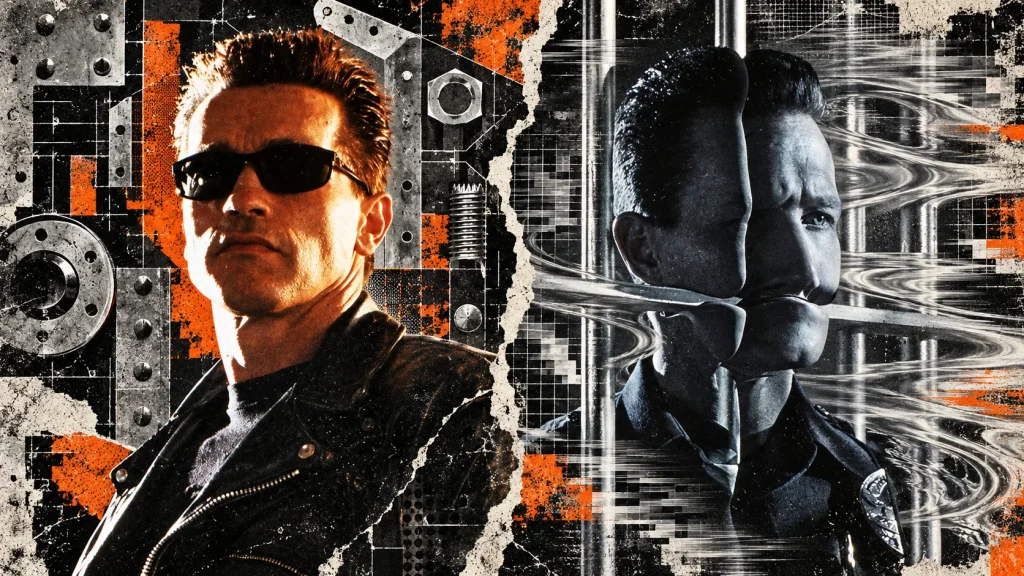
The two machines in Terminator 2 feel as if they came from different decades. The T-800 is built. The T-1000 is executed.
One has a metal skeleton and a removable processor. Damage stays on the body. The other borrows faces, slides through barriers and re-forms after being blown apart. It behaves like a file rewriting itself.
Their fight catches cyberpunk in 1991, as the genre’s attention moved from industrial robotics toward software, virtual spaces and mutable identity.
The T-800 Has an Anatomy
The T-800 belongs to the heavy machinery of 1980s cyberpunk. Arnold Schwarzenegger gives it the posture of a hydraulic press. Under the living tissue sit metal bones and a processor Sarah can lift out by hand.
Its limits make the machine legible. Bullets remain lodged in its back. An arm stays trapped in a gear. The hardware carries every update around as visible wear.
That puts it beside Alex Murphy. RoboCop treats the cyborg as corporate property, while the person inside pushes against the directives. The T-800 has less interior conflict. It still feels assembled from parts a mechanic could name.
The T-1000 Runs on Appearance
The T-1000 has no useful fixed shape. Robert Patrick supplies a default face, yet the machine treats identity as a temporary interface. A police officer grants access. Janelle gives it domestic trust. Sarah becomes the final mask.
This resembles malicious software given a fluid body. It impersonates a trusted user and turns every surface into an entry point. Social space is the network it exploits.
Cyberpunk had already imagined cyberspace as a place the mind could enter. During the 1990s, that virtual logic spread into bodies and identities. Which face is authentic when a system can render any of them?
The Effect Carries the Argument
The production method sharpens the contrast. Industrial Light & Magic combined computer-generated chrome, digitally altered Patrick footage and practical work. The T-1000’s body could be manipulated like image data.
ILM describes Terminator 2 as the first feature to create a lead character at least partly through computer graphics. A new filmmaking system made the new machine possible.
Meanwhile, the World Wide Web was leaving CERN. Its software reached a wider technical audience in 1991, the same year the film opened. The timing proves no influence, but it makes the T-1000 feel tuned to the decade that followed.
The Steel Mill Picks a Side
The climax drags both machines into a steel mill, the perfect home court for the older model. The T-800 understands fixed tools and brute force. The T-1000 remains physical enough to freeze, fracture and melt.
That limit keeps the metaphor honest. Software still requires hardware somewhere. Even an unstable artificial identity needs a surface, just as Blade Runner ties personhood to manufactured bodies.
Terminator 2 catches cyberpunk between two fears. The T-800 can overpower the body. The T-1000 can rewrite what a body means. By the end of the decade, the second problem would dominate the genre.

Daniel writes about cyberpunk, sci-fi, movies, TV, and technology. A lifelong Terminator fan, he’s drawn to stories about machines, identity, rebellion, and the future. CyberPVNK is where he puts those interests to work.